Christopher Thorpe
Dr. Christopher Thorpe is a computer scientist whose research
focuses on security and cryptography in business and finance,
but also includes security and economics of virtual worlds
and how great Internet applications are created.
Christopher Thorpe refers to himself in the
third person at the beginning of the web page so that
search engines excerpt a reasonable part of the page. (This trick worked!)
I am currently the CTO at Blueleaf,
web-based financial planning software.
Contact Info:
Christopher Thorpe
Email: cat eecs.harvard.edu
Tel.: +1 (865) 4-THORPE
Fax: +1 (206) 337-2712
|
|
Obligatory Photo:
|
Disclaimer: I have other things
to do with my time than build an exciting personal web page, but
everything you need should be here. :-)
Academic Affiliations:
Harvard University
- A.B. in Computer Science and Music, 1998
- S.M. in Computer Science, 2006
- Ph.D. in Computer Science, 2008
- My advisors were Michael O. Rabin and David C. Parkes. Avi Pfeffer, my former advisor, honored me by serving on my thesis committee.
Margo Seltzer and
Luis Viceira,
Professor of Finance at Harvard Business School, completed my committee.
- I taught Computer Science 286r a graduate seminar on computational finance, in Spring 2008.
- I have been a teaching fellow over a dozen times, including introductory
computer science, probabilistic reasoning, cryptography
and advanced systems programming.
Research Interests and papers:
- Real-world applications of cryptography, including publicly
verifiable sealed-bid auctions and other e-commerce applications,
spam prevention, email retraction, and electronic voting.
My dissertation,
“Provably Correct, Secrecy Preserving Computation and its Applications in Auctions and Securities Exchanges”, is based on much of the following research
and outlines a general model of efficient, secrecy-preserving
computation, with applications to secure auctions and information
hiding in securities exchanges.
- Christopher Thorpe and Steven Willis, Cryptographic Rule-Based Trading, to appear in Proceedings of Financial Cryptography and Data Security '12 (FC12).
- William Yuen, Paul Syverson, Zhenming Liu, and Christopher Thorpe, Intention-Disguised Algorithmic Trading, Harvard Technical Report TR01-10; a short version appeared in Proceedings of Financial Cryptography and Data Security '10 (FC10).
- Christopher Thorpe, Michael Barrientos, and Michael O. Rabin, Implementation of A Time-Lapse Cryptography Service, Poster, IEEE Symposium on Security and Privacy, Oakland, 2009
- Christopher Thorpe and David C. Parkes: Cryptographic Combinatorial Securities Exchanges, Proceedings of Financial Cryptography and Data Security '09 (FC09).
- David C. Parkes, Michael O. Rabin and Christopher Thorpe: Cryptographic Combinatorial Clock-Proxy Auctions, to appear in Proceedings of Financial Cryptography and Data Security '09 (FC09). (Link is to a pre-proceedings version; please ask permission before redistributing.)
- Michael O. Rabin, Rocco A. Servedio and Christopher Thorpe: Highly Efficient Secrecy-Preserving Proofs of Correctness of Computations and Applications, Proceedings of the 2007 IEEE Symposium on Logic in Computer Science (LICS '07)
- Christopher Thorpe and David C. Parkes: Cryptographic Securities Exchanges, Proceedings of Financial Cryptography and Data Security '07
- Michael O. Rabin and Christopher Thorpe: Time-Lapse Cryptography, 2006, Harvard SEAS Technical Report TR-22-06
- D. C. Parkes, M. O. Rabin, S. M. Shieber, C. A. Thorpe: Practical secrecy-preserving, verifiably correct and trustworthy auctions, published in the 2006 International Conference on Electronic Commerce (ICEC '06) [ACM Citation]
- D. C. Parkes, M. O. Rabin, S. M. Shieber, C. A. Thorpe: Practical secrecy-preserving, verifiably correct and trustworthy auctions (journal version), Electronic Commerce Research and Applications 7:3 (November 2008), pp. 294-312 [ACM Citation]
- Security, economics and art in massively multiplayer online worlds.
- Computer models of music, and their use in tasks such as composer
identification, composition, missing part reconstruction, optical
music recognition, and theoretical analysis
I was primarily advised by the late
David Lewin
whom I consider one of the most influential teachers and mentors
I have ever had. I treasure his comments.
- Automated use of freely available information on the Internet
for predictions in finance
- Natural language analysis of Latin texts to provide
insight on authorship and relationships among authors and texts.
- Systems administration (I try to avoid thinking about this much anymore. This paper was written and accepted when I was an undergraduate.)
Commercial Work:
- In 2011 I co-founded Fresh Pond Partners, an un-incubator. Alternatively: better advising for startups.
- In 2011 I also co-founded CIS Visa to help people with immigration visa applications and the green card diversity visa lottery.
- In 2011 I also co-founded Tddium for Ruby on Rails automated testing and continuous integration.
- In 2009 I cofounded and remain a board member at Blueleaf,
web-based financial planning software.
- From 2000-2002 I worked on internationalization of VoiceXML and speech recognition software at Tellme Networks. I coordinated efforts among dozens of engineers, content developers and speech experts in Belgium and California to deliver an internationalized voice application platform running on North American and European telephony infrastructure. Tellme was acquired by Microsoft in April 2007.
- From 1998-2000 I worked on e-commerce at Yahoo!, after the startup I was with, Viaweb, was acquired by the big Y. Some of my user interfaces are still in use on Yahoo! Store and Shopping. Before leaving, I was responsible for leading the engineering efforts in the internationalization of Yahoo's e-commerce properties, including Auctions, Store, Shopping, Classifieds, and others.
- I am an inventor on US patents 8,024,274 (based on work in my dissertation); and 7,051,024, 6,349,316, and 5,924,108 (including work I did in my Microsoft internship).
- I also founded three startups that didn't make it.
Ask me why.
One answer:
"All successful startups resemble one another,
but each unsuccessful startup is unsuccessful in its own way."
(me, after Tolstoy)
Vocations and Other Interesting Facts:
- I'm now maintaining the collection of Rabinisms, quotes by Michael O. Rabin.
- Singing, conducting, and composing in the style of early music
- Nunc Dimittis, Short Service in A, 2002 (composed and performed by me)
- Nunc Dimittis, Dorian Short Service, 2007. Dedicated to those affected by the tragedy at Virginia Tech in 2007. This recording is by the Harvard University Choir in the premiere performance of my work at the special Memorial Church service in April 2007.
- Corrupting early music; this palestremix was executed by Wayne Marshall after my original concept and heckling during the remix process
- Playing computer games; I am a special fan of escaping into alternate universes such as Azeroth. Level 60's impede research; level 70's even more. Someone commented on one of my characters here.
- Cooking, gardening, and eating the fruits and vegetables of my
labors
- (Usually) funny poetry
- Traveling (where?)
- See my pages on melasthesioma and
the ganectagazoid.
- My Erdős number is 3, via Michael Rabin and Rocco Servedio.
- My degree is a "Philosophiae Doctoris" in "Computationis Rationum Scientiam", a phrase Google didn't know about before I wrote it here.
- My name has some interesting characteristics:
- When I was young, I
noticed an interesting anagram I will leave as a puzzle.
Heinrich Christensen noticed it without prompting;
Noam Elkies, upon meeting my parents, asked them if they
had intentionally given me a name with this property.
(I don't know whether he'd noticed it before then.)
After reading this, Florin Constantin observed that “short cipher” is an anagram for Chris Thorpe, but the one I'm talking about is even more self-referential than a topic relating to my research.
Shiyang Cao, Paul Syverson, Elias Ladopoulos, Will Yuen, Tianyi Zhu, Thomer Gil and Kent Kemeny also figured it out.
- The first six letters of my first name, or my short first
name and last initial make for unfortunate abbreviations:
- When I was at Microsoft, they nearly gave me the email
address t-christ@microsoft.com
(I got t-cthorp).
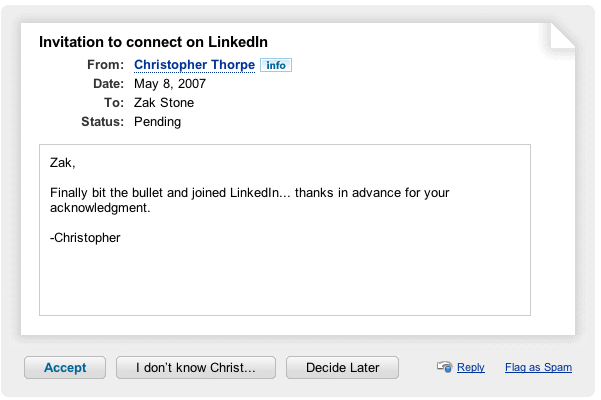
- When I joined LinkedIn,
my contacts were invited to accept my invitation,
decide later, or say "I don't know Christ...".
Zak Stone provided a screenshot.
- Amazon.com apparently
does know Christ.... (Now it reads
"Not Christo...?", que me gusta tambien.)
- Sometimes people just make mistakes.
- I speak English, Spanish, Portuguese, French, German, and Dutch
well enough to have meaningful conversations, which means I can also
understand and usually fake Italian.
I also studied some Russian and Japanese and know enough Mandarin to
surprise people. And I know how to say "rain" in Malayalam.